
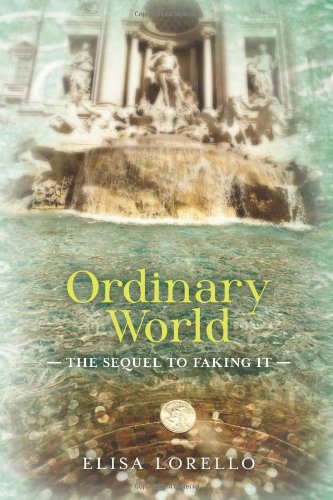
Ordinary World Overview
Six years after leaving New York, Andi has everything she wants: a tenured professorship at Northampton University in Massachusetts, a published collection of essays, good friends, and a blissful relationship with her husband. But what happens when tragedy strikes and the world as she knows it changes in an instant?
Author Elisa Lorello reunites us with Andi and has created a story of love and loss, joy and sorrow, and heartbreak and hope, all the while keeping us hooked through the laughter and tears.
Ordinary World Specifications
Book Description: Readers who fell in love with Andi Cutrone in Elisa Lorello’s first novel, Faking It, can now join Andi on a new journey in which she faces a challenge unlike any she has ever known. Ordinary World begins six years after Lorello’s first installment left off: Andi is blissfully married, works as a recently tenured professor at Northampton University, and is a published author. Life is ideal—until her husband’s death in a senseless accident shatters Andi’s world, plunging her into a gulf of depression and grief. Her family and friends do what that they can to ease her anguish, but no one seems to have the right words to heal Andi’s pain. On the advice of a friend, she travels to Italy to escape and unexpectedly runs into the man who once helped her discover her authentic self. As their friendship is renewed, Andi finally begins to heal, daring to hope that someday she will be happy again. Both wrenching and uplifting, Ordinary World is a moving tale of love and loss, joy and sorrow, heartbreak and hope.
Amazon Exclusive: Elisa Lorello on Ordinary World
Question: When, and how, did you know that Andi Cutrone's story wasn't finished? Was it before or after Faking It came out? Did you always have the rest of the
 story in mind or did it develop while you wrote it? Elisa Lorello: Once I knew how Faking It was going to end, I pretty much knew that Andi’s story wasn’t going to be over. It was more a gut feeling than anything else. However, I had no idea at that time where the story was going to go or what was going to happen to her. It wasn’t until several years later, after I had relocated, that I knew what the story was going to be. And I was resistant at first because by then I had gotten so close to these characters and didn’t want them to be hurt. But when a story or a truth needs to be told, as a writer you have to honor that and get out of its way. But I definitely grieved with Andi and rooted for her all the way. Question: You manage to turn the concept of an "ordinary" life into an extraordinary novel. And yet, being ordinary isn't something people are prone to want. How did you keep Andi's seemingly "everyday" goals compelling for the reader? Elisa Lorello: That’s an interesting question. For much of the book, Andi’s everyday goals were nothing more than to get through the day, and I think a lot of readers got frustrated with her because for every step forward she took three steps back. I think that, in many ways, is an ordinary response to extraordinary circumstances. But the idea of finding solace in ordinary things--a cup of coffee, a book, a walk in the park, etc.--was ultimately the healing point for Andi and made life extraordinary. And I think that’s something we can all apply to our lives. We don’t need a traumatic experience to do so. Question: The rhetoric elements in the novel are quirky and fun and really give the reader a bird's eye view into the world of academia. As a Rhetoric teacher, how much of your own college and teaching experience did you include and how much is simply your imagination? Elisa Lorello: The rhetorical elements are all from what I learned and practiced, and pretty much parodied my own teaching philosophies at the time. I was fresh out of grad school when I wrote Faking It, so it’s kind of funny now to see how I sort of threw in everything I knew and loved, and how green and idealistic it is. I also watched a lot of The West Wing at the time and couldn’t help but absorb the style of dialogue--that’s not to say that I was trying to write like Aaron Sorkin, but it was definitely influential and something that I think worked really well in both novels. I still love how wonderfully rhetorical both novels are.
 I so feel for Andi when she has that meltdown in front of her students in Ordinary World. In terms of my own emotional connection to the character, it was one of the hardest scenes to write.
Question: You're currently working on your next book. Anything you can share with us before it comes out? Elisa Lorello: I’m one of those people who are really superstitious about revealing any detail about a work in progress. All I’ll say is that I’m taking a new approach by writing it from the point of view of two different characters, one of which is written in third person and is male. I’m also back to writing solo after collaborating on Why I Love Singlehood.

 Posts
Posts


No comments:
Post a Comment